Few buildings anywhere on the planet have reshaped a national identity as decisively as the Petronas Twin Towers reshaped Malaysia's. Rising 451.9 metres above the centre of Kuala Lumpur, these identical steel-and-glass spires have served as the country's foremost symbol of ambition, modernity, and cultural pride since their completion in 1998. Their story begins not with an architect's sketch but with a political vision that would transform a patch of swampy racecourse land into one of the most valuable real-estate precincts in Southeast Asia.
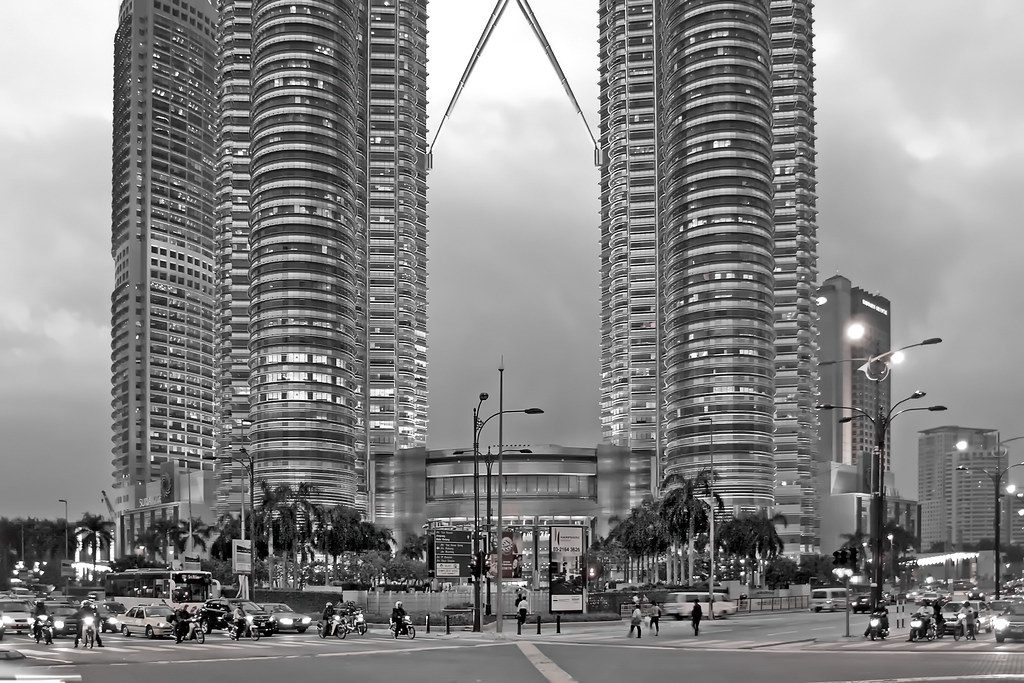
A classic monochrome perspective of the twin towers against the Kuala Lumpur skyline.
A National Vision — 1981–1991
The seeds of the Petronas Twin Towers were planted during the early tenure of Malaysia's fourth Prime Minister, Dr. Mahathir Mohamad, who took office in 1981. Mahathir was a vocal advocate of rapid industrialisation, and he believed Malaysia needed a dramatic architectural statement to signal its arrival on the world stage. Throughout the 1980s, Kuala Lumpur grew quickly, but it still lacked a landmark that could rival the skylines of Hong Kong, Singapore, or Tokyo.
In 1991, the government announced plans to develop the Kuala Lumpur City Centre, a 100-acre mixed-use precinct on the site of the former Selangor Turf Club. PETRONAS, the state-owned oil and gas corporation, was appointed the anchor tenant and primary developer. From the outset, Mahathir insisted that the centrepiece of the new district should not merely be tall — it should be the tallest building on Earth, surpassing Chicago's Sears Tower, which had held the record since 1973.
The Design Competition — 1991–1992
An international design competition was launched in 1991, attracting submissions from some of the most prestigious architecture firms in the world. Eight finalists presented schemes, but it was the entry from César Pelli & Associates of New Haven, Connecticut, that captivated the selection committee. Pelli proposed twin towers connected by a sky bridge, each built on a floor plan derived from overlapping squares — a geometric motif deeply rooted in Islamic art and Malaysian heritage.
Pelli later explained that he deliberately sought a design that felt distinctly Malaysian rather than generically Western. The eight-pointed-star floor plate, known in Islamic geometry as the Rub el Hizb, gave the towers a silhouette unlike any other skyscraper and allowed generous corner offices with panoramic views. The committee was unanimous in its praise, and Pelli was officially appointed lead architect in January 1992.
"I wanted a building that was of its place, not something you could pick up and drop in Houston or London. The geometry had to speak the language of Malaysian culture." — César Pelli
Planning and Pre-Construction — 1992–1993
The period between 1992 and 1993 was consumed by an extraordinary amount of planning. Structural engineering was led by Thornton Tomasetti (Tower One) and Ranhill Bersekutu (Tower Two), with key contributions from engineers including Dr. Charles Thornton and Bill Baker. The soil beneath the site presented an immediate challenge: bore-hole surveys revealed that bedrock lay at vastly different depths beneath the two tower footprints — as deep as 200 metres in some locations. The entire project was ultimately shifted 60 metres southeast to find a more uniform limestone base.
Even after relocation, the geotechnical conditions demanded an unprecedented foundation solution. Engineers designed a massive reinforced-concrete raft for each tower, supported by friction piles driven up to 104 metres into the ground. At the time, these were among the deepest building foundations ever constructed, and the piling programme alone consumed more than 13 months of work.
Key People in the Planning Phase
César Pelli — Lead architect from César Pelli & Associates. Fred Clarke — Project director overseeing day-to-day design coordination. Bill Baker — Structural engineer (Skidmore, Owings & Merrill consultant) who contributed to wind-load analysis. Dr. Charles Thornton — Founder of Thornton Tomasetti, responsible for Tower One's structural design. Dr. Mahathir Mohamad — Prime Minister who championed the project and insisted on a world-record height.
Construction Milestones — 1993–1998
Ground was broken in March 1993. In an unusual arrangement designed to accelerate the schedule, two separate main contractors were appointed: Hazama Corporation of Japan was awarded Tower One, while Samsung Engineering & Construction of South Korea took Tower Two. Each team operated with its own workforce, subcontractors, and equipment, creating an informal but fiercely motivated construction race between the two sides.
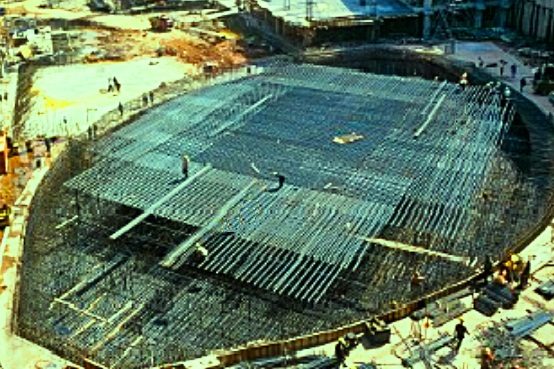
Reinforcement placement during the massive foundation piling programme, circa 1994.
March 1993
Official groundbreaking ceremony; excavation and piling begin on both tower footprints.
September 1994
Foundation rafts for both towers completed — each raft containing over 13,000 cubic metres of concrete poured in a single continuous operation lasting more than 50 hours.
April 1995
Superstructure steel erection begins; the distinctive jump-form concrete cores start rising.
March 1996
Tower Two briefly leads Tower One by several floors, intensifying the informal rivalry between Samsung and Hazama.
December 1996
Both towers reach the 72nd floor; Skybridge steel segments are lifted into position at levels 41–42 over two dramatic weekends.
March 1997
The pinnacles (spires) are set atop both towers, bringing the total height to 451.9 metres and officially surpassing the Sears Tower's roof height.
January 1998
Exterior cladding and interior fit-out nearing completion. Suria KLCC shopping centre opens on the lower levels.
28 August 1998
Prime Minister Mahathir officially opens the Petronas Twin Towers on the eve of Malaysia's National Day.
The Height Debate
When the spires were placed in 1997, the Petronas Twin Towers claimed the title of the world's tallest buildings at 451.9 metres. However, this triggered a spirited debate within the architectural community. The Sears Tower (now Willis Tower) in Chicago, completed in 1973, has a roof height of 442 metres — higher than the Petronas roof at 378 metres — but its antenna masts were not counted as part of the structural height.
The Council on Tall Buildings and Urban Habitat (CTBUH), the recognised authority on skyscraper measurements, ruled in favour of the Petronas Towers. The CTBUH determined that architectural spires, because they are integral to the building's design, count towards official height, whereas antennas and masts do not. This ruling codified a standard that is still applied today and effectively confirmed the Petronas Twin Towers as the tallest buildings in the world from 1998 until Taipei 101 surpassed them in 2004.
Cultural and Economic Significance
The impact of the Petronas Twin Towers on Malaysia cannot be overstated. They opened during the Asian financial crisis of 1997–1998, a period of severe economic turbulence that battered currencies and stock markets across the region. Rather than being viewed as an extravagance, the towers became a rallying symbol of Malaysian resilience and determination. Images of the illuminated towers were broadcast worldwide, and tourism to Kuala Lumpur surged in the years that followed.
The KLCC precinct that surrounds the towers has evolved into one of Southeast Asia's premier commercial and leisure districts. Suria KLCC, the six-storey shopping mall at the base, attracts more than 40 million visitors annually. The adjacent KLCC Park, designed by the late Brazilian landscape architect Roberto Burle Marx, offers 20 hectares of lush greenery, a jogging track, a children's playground, and the iconic Lake Symphony fountain. Together, these elements transformed what was once an underutilised racecourse into a vibrant urban centre that generates billions of ringgit in economic activity every year.
Post-Completion History and Records
Since their opening, the Petronas Twin Towers have maintained their status as the world's tallest twin towers — a record they still hold in 2026, more than a quarter-century later. While individual buildings have long since overtaken their height (the Burj Khalifa in Dubai stands at 828 metres), no twin-tower complex has been built to match them.
The Skybridge, initially open only to Petronas employees, was opened to the public in 2005 after enormous visitor demand. An observation deck on Level 86 followed, offering panoramic views stretching to the Straits of Malacca on clear days. Annual visitor numbers to the towers have grown steadily, and in recent years the complex has welcomed more than two million ticketed visitors per year to the Skybridge and observation deck alone.
In 2019, the towers underwent a major LED lighting upgrade that replaced the older fluorescent system, reducing energy consumption by approximately 80 percent while enabling dynamic colour displays for national holidays and global events. The project underlined the building's commitment to sustainability in its third decade of operation.
César Pelli, the visionary architect behind the design, passed away on 19 July 2019 at the age of 92. His legacy lives on not only in the Kuala Lumpur skyline but in the worldwide recognition that the Petronas Twin Towers have earned as one of the defining architectural achievements of the twentieth century.
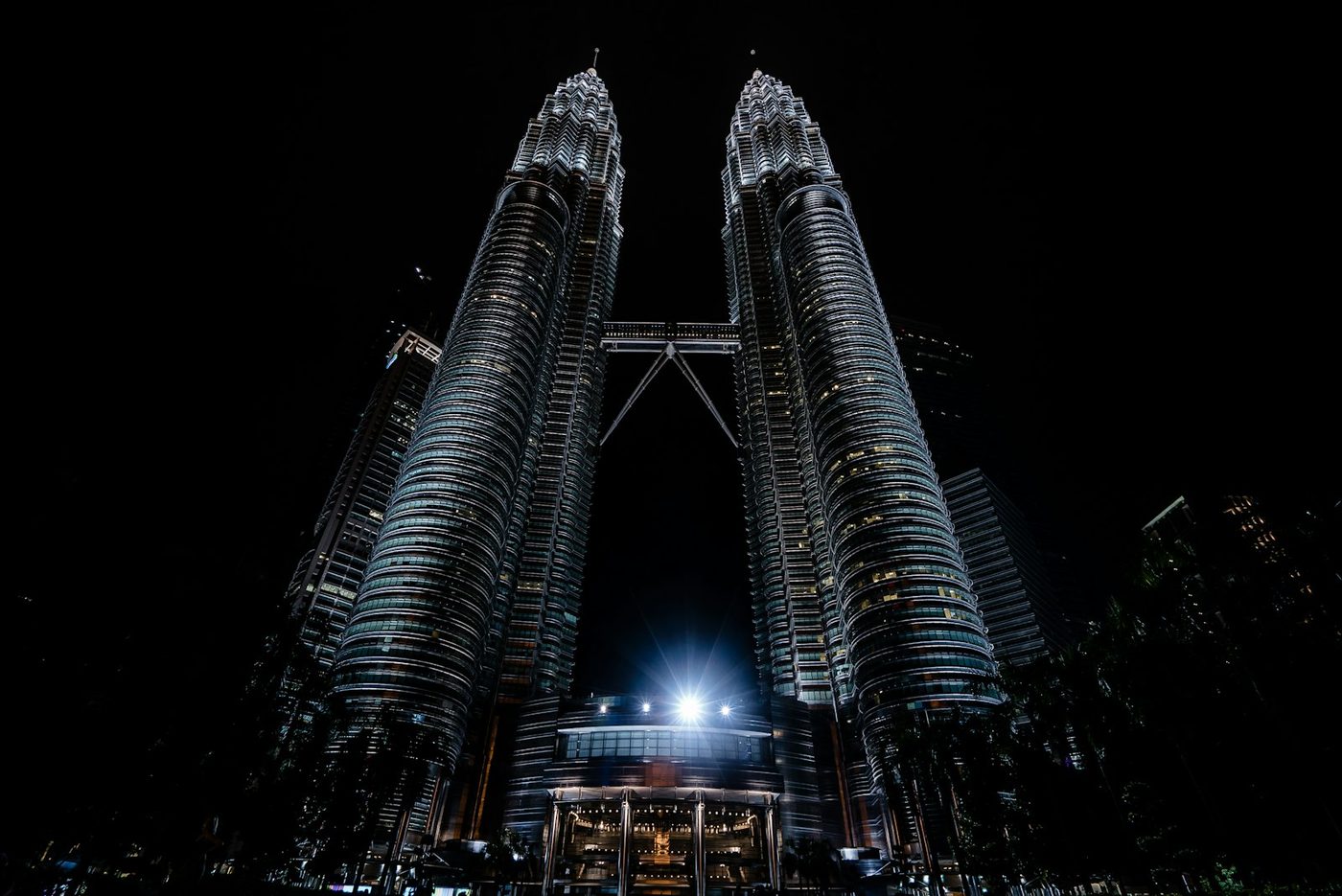
The towers shimmer against the night sky, a sight that has become synonymous with modern Kuala Lumpur.
A Living Legacy
Today, the Petronas Twin Towers house the headquarters of PETRONAS, along with offices for multinational companies, the Dewan Filharmonik Petronas concert hall (one of the finest acoustically designed halls in Asia), an interactive science discovery centre, and a mosque. The towers remain a fully active commercial complex, a world-class tourist destination, and the emotional heart of Malaysia's capital city.
Their story is far from over. Plans for ongoing sustainability retrofits, digital visitor experiences, and expanded public programming ensure that the Petronas Twin Towers will continue to evolve while preserving the audacious spirit that brought them into being more than three decades ago.
Continue Reading
Delve deeper into the technical brilliance behind the towers in our Architecture & Engineering article, or discover the human drama of the build in The Construction Story.