Building the Petronas Twin Towers was not simply a matter of engineering — it was a human drama played out over five gruelling years on one of the most challenging construction sites in Southeast Asia. This is the story of the people, the problems, and the ingenious solutions that turned a swampy racecourse into the home of the world's tallest twin towers.
The Two-Contractor Approach
From the start, the Petronas project was organised in a way that had no real precedent in supertall construction. Rather than awarding the entire job to a single main contractor, KLCC Holdings appointed two: Hazama Corporation of Japan was given Tower One (the west tower), while Samsung Engineering & Construction of South Korea received Tower Two (the east tower). A third consortium, led by the Malaysian firm MMC-Gamuda, handled the podium, basement, and KLCC Park.
The rationale was partly logistical — splitting the work between two teams allowed excavation and superstructure work to proceed simultaneously on both footprints, shaving months off the overall schedule. But the arrangement also introduced a powerful psychological dynamic. Although the two contractors were nominally working toward the same deadline, they were also acutely aware that the other team was watching. Floor counts were compared weekly, and any delay on one side was immediately noticed by the other.
This informal competition, which both companies publicly downplayed but privately embraced, produced some remarkable results. The towers went up at an average rate of one floor every four to five days during peak construction — an extraordinary pace for structures of this complexity.
Breaking Ground — The Foundation Challenge
When excavation began in March 1993, the contractors immediately confronted the site's most formidable obstacle: the geology. The original tower footprints sat partly over competent Kenny Hill rock and partly over highly irregular Kuala Lumpur Limestone, a formation riddled with solution channels, cavities, and unpredictable pinnacles. Bore-hole surveys revealed bedrock depths ranging from 40 metres to more than 200 metres beneath the surface — a variation so extreme that conventional end-bearing piles were simply not feasible.
The entire building complex was repositioned approximately 60 metres to the southeast to take advantage of a more uniform substratum, and engineers devised a system of rectangular barrette piles socketed into the limestone by friction. Each pile measured 2.8 metres by 0.8 metres and extended between 40 and 104 metres underground. Drilling and concreting more than 400 of these elements took the better part of a year and required round-the-clock operations.
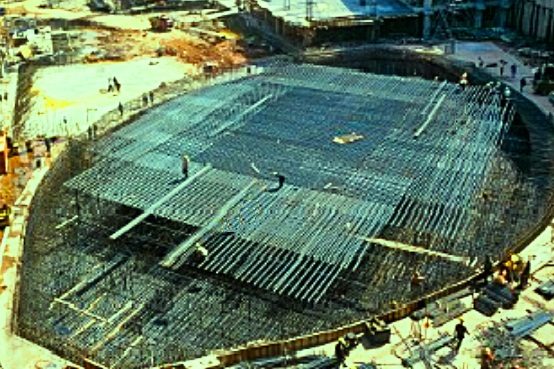
Reinforcement cages being prepared for the massive barrette pile foundations.
Above the piles, each tower rests on a reinforced-concrete raft 4.6 metres thick. Pouring each raft was a Herculean operation: roughly 13,200 cubic metres of concrete had to be placed continuously — without any cold joints — in a single pour lasting over 54 hours. Hundreds of concrete trucks cycled through the site in relay, and the operation was monitored around the clock by teams of engineers checking temperature, slump, and curing conditions.
The Construction Race
As the superstructure began rising in early 1995, the competition between Hazama and Samsung intensified. Samsung's South Korean workforce had an aggressive construction culture and a regimented approach to scheduling. Hazama's Japanese team was equally meticulous but favoured a more deliberate quality-assurance process. For several months, the towers climbed neck and neck, but by early 1996, Samsung had pulled ahead by two to three floors.
The gap prompted a burst of innovation on the Hazama side. Hazama's engineers refined their jump-form system — the climbing formwork that shapes each new floor of the concrete core — to reduce cycle times by nearly half a day. They also reorganised logistics, repositioning tower cranes and establishing dedicated material staging areas to eliminate bottlenecks. By mid-1996, the two towers were once again rising in tandem, and they ultimately topped out within days of each other in early 1997.
"There was never a formal race, but everyone on site knew exactly what floor the other team was on. It pushed both sides to perform at their absolute best." — Project management team member, recollected in a 2005 documentary
Rising the Concrete Cores
The structural heart of each tower is a massive reinforced-concrete core measuring roughly 23 metres square at the base and tapering as it rises. The core houses elevator shafts, stairwells, and service risers, and it provides the primary lateral resistance against wind forces. Constructing this core required a continuous cycle of reinforcement tying, formwork climbing, and concrete placement that repeated every four to five days.
A fleet of concrete pumps stationed at ground level pushed the mix through high-pressure pipelines to the working floor — a vertical lift that eventually exceeded 400 metres. Maintaining workable concrete at these pump distances demanded a specially formulated high-performance mix with superplasticisers and retarders calibrated to Kuala Lumpur's hot, humid climate. On several occasions, pipeline blockages at extreme heights forced emergency interventions that cost hours of schedule time.
Surrounding the core, 16 large cylindrical concrete columns rose in parallel, connected to the core by ring beams at every floor. Steel floor beams spanned from the core to the perimeter columns, supporting composite metal-deck floor slabs that were poured on a just-behind-the-core schedule. At peak activity, more than 7,000 workers were on site simultaneously across both towers.
Skybridge Installation
Perhaps the single most dramatic episode in the entire construction programme was the installation of the Skybridge at Levels 41–42 in late 1996. The 750-tonne, 58-metre-long bridge was fabricated on the ground between the two towers in three main segments. Lifting it into position at a height of 170 metres required a method that had never been attempted at this scale.
Engineers from Thornton Tomasetti devised a strand-jack lifting system — hydraulic rams pulling on high-strength steel cables — to raise each segment from ground level to the connection points on the tower legs. The lifts were performed over two consecutive weekends to minimise disruption to the surrounding city centre. Each segment took approximately 12 hours to travel from the ground to its final elevation, rising at a measured pace of roughly one metre every four minutes.
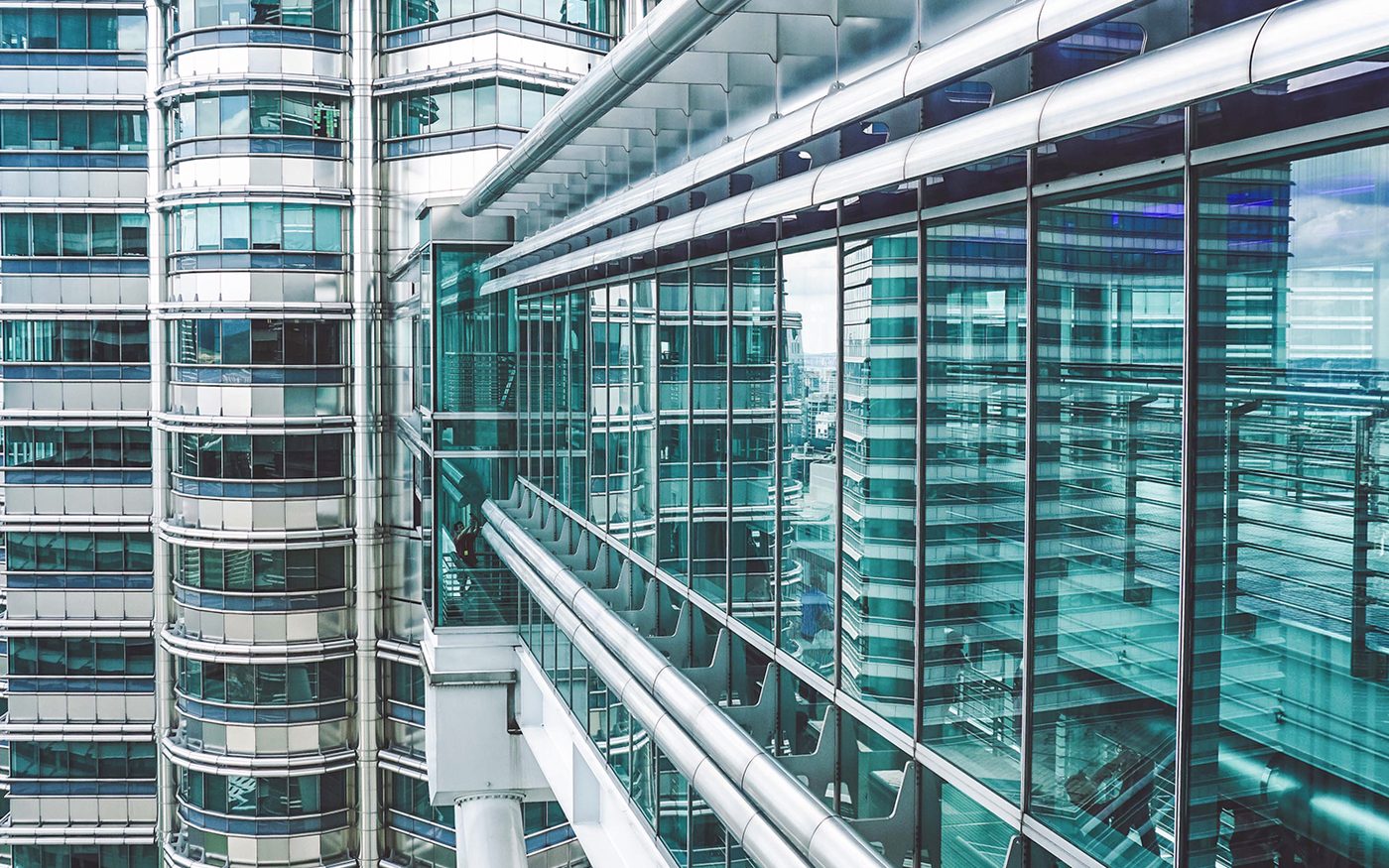
The view from the Skybridge level — a reward for one of the most daring lifts in construction history.
Once in position, the bridge segments were bolted together and connected to the towers via spherical bearings that allow independent sway. The system is designed to accommodate differential movement of up to 300 millimetres between the two towers — a critical safety requirement in a region subject to both monsoon winds and occasional seismic tremors.
Topping Out — The Pinnacles
Each tower is crowned by a 73.5-metre stainless-steel pinnacle that brings the total height to 451.9 metres. The pinnacles were fabricated in sections and hoisted to the rooftop by the tower cranes, then assembled vertically in a painstaking process that required millimetre-precision surveying. High winds at the summit meant work could only proceed during calm morning hours; on several occasions, the crew had to suspend operations for days at a time while waiting for favourable conditions.
When the final pinnacle section was bolted into place on Tower Two in March 1997, the Petronas Twin Towers officially surpassed the Sears Tower's structural height and claimed the title of the world's tallest buildings. The moment was marked by a modest ceremony atop the tower attended by engineers and construction workers — many of whom had spent the better part of four years living in on-site dormitories.
Cladding and Fit-Out
While the structural frame raced upward, cladding teams followed behind, installing the stainless-steel and glass curtain wall from specialised cradle systems suspended from each floor's edge. The curtain-wall panels were shipped from fabrication facilities in Italy, and the installation sequence was carefully choreographed to maintain pace with the rising structure without creating dangerous overhead hazards for workers below.
Interior fit-out proceeded floor by floor, with dedicated teams handling mechanical services, electrical wiring, elevator installation, and architectural finishes. The 76 elevators in each tower — manufactured by Otis — included double-deck units capable of serving two floors simultaneously, a technology that significantly reduced elevator shaft requirements and freed up rentable floor area.
Safety and Resilience
Safety was a top priority throughout construction, though the sheer scale of the project and the era in which it was built meant that standards differed from today's norms. At peak, more than 7,000 workers were on site each day, operating heavy cranes, concrete pumps, and welding equipment at heights exceeding 400 metres. Both Hazama and Samsung implemented rigorous safety programmes including daily toolbox talks, mandatory personal protective equipment, and regular third-party audits.
The completed towers incorporate a comprehensive fire-safety system with pressurised stairwells, refuge floors at mechanical levels, a dedicated fire-command centre, and one of the largest sprinkler installations in Southeast Asia. The structural system was designed to withstand winds far in excess of any recorded storm in the region, and the concrete cores provide inherent fire resistance rated at four hours — well above international code requirements.
Seismic resilience was also considered, despite Kuala Lumpur's relatively low seismicity. The reinforced-concrete structure and deep pile foundations provide excellent energy absorption, and the Skybridge's articulated bearing system ensures that differential movement between the towers during a seismic event will not compromise the connecting structure.
By the Numbers
Construction Statistics
Duration: 1993–1998 (5 years) · Peak workforce: 7,000+ daily · Concrete volume: ~320,000 m³ (both towers) · Steel reinforcement: ~36,000 tonnes per tower · Curtain wall area: ~167,000 m² total · Elevators: 76 per tower (152 total) · Barrette piles: 400+ (depths to 104 m) · Raft pour duration: 54+ hours continuous · Skybridge weight: ~750 tonnes · Total project cost: ~US $1.6 billion
The Petronas Twin Towers were handed over to their owner, KLCC Holdings, in stages throughout 1998, and Prime Minister Mahathir officially opened the complex on 28 August 1998 — the eve of Malaysia's 41st National Day. The event was bittersweet: the Asian financial crisis had battered the Malaysian economy, but the gleaming towers stood as a powerful statement that the nation's ambitions were far from extinguished.
Keep Exploring
Go back in time with our Complete History, or look forward to your own visit with the Visitor Guide.